
Smart city deployments in 2025–2026 are shifting from flashy pilots toward ROI-driven, scalable infrastructure like smart lighting, waste, parking, and environmental monitoring, with AI increasingly layered on top for traffic, safety, and climate resilience.digi+1youtube
Deployment trends (2025–2026)
-
Cities are consolidating scattered pilots into manageable asset networks (lighting, waste, parking) rather than “everything everywhere” experiments.iottechnews
-
Procurement is now led by ROI, operational savings, and service quality instead of tech-first experimentation.iottechnews
-
Public–private partnerships and platform-based architectures are becoming the default way to fund and operate smart city IoT.spectrumsmartcities+1
-
Post‑pandemic requirements (touchless interactions, safety, community resilience) continue to drive new use cases and sensor deployments.spectrumsmartcities
-
AI is moving smart cities from simple monitoring to prediction and simulation (traffic optimization, incident detection, climate risk).youtubespectrumsmartcities
Core infrastructure: lighting, waste, parking, environment
-
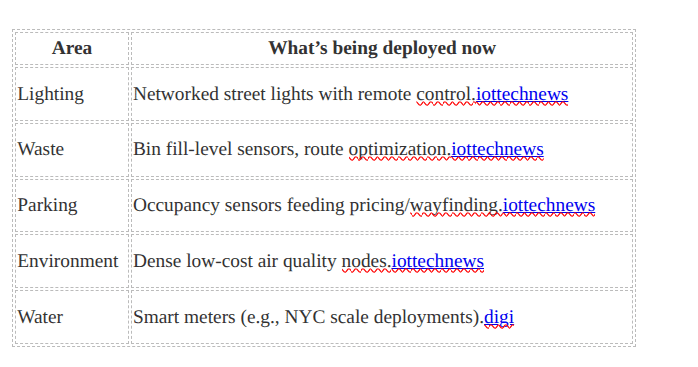
Smart street lighting is now a mature “default”: ~27.9M individually controlled smart street lights (ex‑China) were installed in 2024, forecast to reach 74.5M by 2029 (≈21.8% CAGR).iottechnews
-
Smart waste (fill‑level sensors on bins) is the fastest‑growing non‑surveillance segment, with 1.56M units in 2024 and ~22.3% CAGR projected to 2029.iottechnews
-
Smart parking (ground/surface occupancy sensors) hit 1.47M sensors globally in 2024, growing steadily at ~18.4% CAGR.iottechnews
-
Outdoor air‑quality sensor networks are densifying: ~206,000 non‑regulatory monitors in 2024 projected to ~633,000 by 2029.iottechnews
-
Fixed and mobile video/audio surveillance remains the largest category by value, with a 2024 market of about $16.21B and ~15.6% CAGR.iottechnews
Notable city programs and recent lists
-
New York City is highlighted in 2026 rankings for broad IoT deployments, including LinkNYC kiosks and large‑scale smart water metering across 800,000+ connections.digi
-
Boston is frequently cited for citizen‑centric services—mobile apps for reporting potholes/graffiti, parking information, and school bus tracking.een
-
Singapore’s “Smart Nation” and eco‑smart, largely vehicle‑free Tengah project continue to be reference models for integrated transport, payments, and sustainable urban design.earth
-
Nordic cities like Helsinki and Oslo are pushing hard on electrified transport and carbon‑neutrality targets using smart infrastructure and charging networks.earth
-
Colorado Smart Cities Alliance lists nearly 100 collaborative projects among member cities, including new deployments in Greeley and Colorado Springs that are positioned as scalable exemplars.coloradosmart
Example table: where deployments are concentrated
example smart city
Technology and business model shifts
-
Smart city platforms are evolving from legacy, siloed IT contracts toward integrated, API‑driven, data‑centric ecosystems that can ingest multiple verticals (mobility, utilities, public safety).marketsandmarkets
-
Cities are explicitly designing for interoperability so lighting, parking, and waste data can share infrastructure (networks, platforms, analytics).marketsandmarkets+1
-
Gartner and others see IoT in cities moving toward predictive capabilities when combined with AI/ML and simulation tools.spectrumsmartcities
-
PPP models are used to relieve municipal budget constraints and bring in private capital and expertise for IoT initiatives.spectrumsmartcities
-
Regional patterns: Europe leads adoption outside China; North America is second; the fastest growth is in Middle East and APAC thanks to rapid urbanization and national‑level programs.iottechnews
AI‑enabled smart city use cases
-
AI‑powered traffic management networks (e.g., Taiwan’s large smart traffic network with >100 AI‑controlled signals) are being deployed to cut congestion and emissions.youtube
-
Cities like Orlando are piloting AI to support emergency response, climate resilience, and population/infrastructure stress management.youtube
-
Video analytics (object detection, incident recognition) are increasingly integrated with existing surveillance infrastructure.youtubeiottechnews
-
Predictive maintenance for utilities, roads, and public assets is emerging from combined IoT + AI pipelines.spectrumsmartcities+1
-
Generative AI is starting to be framed as a “Smart City 4.0” layer for planning, citizen interaction, and scenario simulation
Case Study
Globally, the Vietnam deployment is a strong case study, but it’s sitting inside three bigger currents: rapid growth of AI/voice‑enabled kiosks, a shift to audio‑first UX in smart city/public service contexts, and emerging AI regulation that will increasingly touch these terminals.documents.worldbank+2
Global deployment and market trends
-
AI‑enabled kiosk market worldwide is growing fast, with estimates in the mid‑teens CAGR through 2030 (≈14–15%), driven by government, transport, healthcare, and retail. https://www.openpr.com/news/4562606/ai-powered-interactive-kiosks-market-to-expand-rapidly-over
-
Voice, computer vision, personalization, and predictive maintenance are now standard talking points in vendor literature, not edge cases. sitekiosk+1
-
Use cases span transit (ticketing, wayfinding), government (registration, licensing, document services), healthcare (check‑in, triage), and retail/QSR (ordering, loyalty).igi-global+2
-
Outdoor “smart city” kiosks with integrated voice and noise‑handling are starting to ship (e.g., Korean outdoor smart city kiosks with voice recognition and audio hardware baked in). kioskindustry+1
-
Vendors pitch AI kiosks as “intelligent self‑service hubs” that augment or partially substitute for staffed counters, including in municipal environments.kioskmarketplace+2
Audio and voice as core interaction
-
Voice recognition is increasingly positioned as the ideal touchless interface, reducing user contact, supporting accessibility, and enabling “talk to the kiosk” workflows.kardome+1
-
Real‑time speech recognition plus multi‑language support is now common in spec sheets, aimed at inclusive public‑facing deployments. sitekiosk+1
-
Smart city kiosks (transport, tourism, public service) are being designed with microphones, speakers, and signal processing to handle noisy streets. kioskindustry+1
-
Voice + NLP is used to capture free‑form questions and map them into guided flows, similar to the Vietnam kiosk’s “talk to the assistant” model but now seen in retail, banking, and healthcare too.cybertech+2
-
Vendors highlight accessibility benefits (elderly, low literacy, no smartphone) to justify voice investment when pitching city deployments.kardome+1
Public service / smart city kiosks beyond Vietnam
-
In addition to Vietnam’s AI public kiosks, governments globally are experimenting with AI kiosks for ticketing, vehicle registration, permits, and information desks.infinitebs+1
-
Outdoor smart city kiosks with voice/intercom are marketed for transport stops, public buildings, and city information points (emergency calls plus guided info).kioskindustry+1
-
Airports, rail stations, and municipal campuses are early adopters, combining AI chat, wayfinding, and document guidance into integrated kiosks. kioskmarketplace 2024
-
Healthcare systems deploy AI kiosks for patient check‑in, symptom triage, and appointment scheduling, often integrated with EMR backends—similar architecture to a government services kiosk. sitekiosk+1
-
Globally, the narrative is shifting from “standalone kiosk” to “node in an omnichannel ecosystem” that ties into apps, portals, and call centers.igi-global+1
Regulatory and governance trends (global lens)
-
The World Bank and others note a clear trend: more countries are adopting AI‑specific governance frameworks, including for public administration.documents.worldbank
-
Vietnam’s AI law and ethics framework are one example of a comprehensive, standalone AI law that explicitly covers public‑sector AI and requires transparency and risk classification.documents.worldbank+2
-
In the U.S., there is still no comprehensive federal AI statute, but there are executive orders and sectoral efforts plus state‑level laws on algorithmic discrimination and AI governance.wikipedia+2
-
Many jurisdictions require public bodies to publish AI use policies, risk assessments, or registers, which would cover public‑service kiosks if they use AI.documents.worldbank+1
-
Globally, recurring themes are transparency (disclosing AI use), human‑in‑the‑loop oversight, data protection, and prohibitions on manipulative or discriminatory use of AI systems.documents.worldbank+2
How audio + AI + regulation converge for kiosks
-
Voice and conversational AI in public kiosks raise new regulatory questions: disclosure (“you are talking to AI”), consent, data retention of voice logs, and bias/fairness in automated guidance.documents.worldbank+2
-
Kiosks that use biometric or voiceprint recognition for authentication sit at the intersection of AI law, privacy, and sometimes sectoral rules (finance, health, transport).documents.worldbank+1
-
As AI laws (Vietnam, EU AI Act‑style frameworks, national strategies) come into force, public kiosks will likely be classified by risk tier, which drives obligations for testing, monitoring, and documentation.documents.worldbank+2
-
Requirements to label synthetic/AI‑generated audio or outputs could force explicit audio cues and UI indicators on voice‑first kiosks worldwide.documents.worldbank+2
-
For smart city deployments, AI governance will increasingly be tied to procurement and funding; RFPs may specify explainability, logging, human override, and accessibility standards for AI kiosks.documents.worldbank+1
Framing Vietnam as a global case study
-
The Dong Tien kiosk is an early “full‑process AI public service kiosk” with voice, OCR, ID integration, and back‑office connectivity—exactly the type that global regulators are starting to think about.kioskindustry+2
-
It demonstrates how voice‑first UX, rural inclusion goals, and AI‑specific law (risk tiers, transparency, ethics) can co‑exist in a single deployment.blogs.duanemorris+2
-
Compared to typical retail/transport AI kiosks, it sits deeper in administrative processes, which magnifies governance implications and makes it a good benchmark for “AI‑governed kiosks.”documents.worldbank+2
-
From a TIG perspective, it can anchor a global narrative: “Vietnam shows where smart city kiosks go when AI, audio, and regulation converge,” then branch into other regions’ trajectories (US, EU, Korea, etc.).kioskindustry+2
-
It’s also a contrast case: rural, government‑centric, and ethics‑framed, versus typical urban retail or transport kiosks that are driven primarily by CX and revenue
Global Markets
Fastest growth in “smart city technology” is coming from specific segments (especially smart energy) and from regions in Asia–Pacific and the Middle East that are aggressively funding urban digital infrastructure.statescoop+2
Fastest‑growing segments inside smart cities
-
Smart energy (smart grids, metering, energy management) is repeatedly identified as the fastest‑growing segment within smart city platforms.statescoop
-
Smart infrastructure (transport, lighting, buildings) holds the largest revenue share but grows slightly slower than smart energy.statescoop
-
Mobility and transportation tech (EV charging, connected street lights, traffic management) are strong growth contributors off infrastructure and climate funding.fas+1
-
Data platforms and analytics (centralized city platforms, AI/IoT data lakes) show high double‑digit growth as glue for all verticals.marketsandmarkets+1
-
Overall smart city markets are projected to grow at roughly mid‑teens to low‑twenties CAGR through 2030–2035, reaching multi‑trillion‑dollar scale.grandviewresearch+2
Regional markets growing fastest
-
Asia–Pacific is consistently cited as the fastest‑growing regional smart city market, driven by rapid urbanization and large national programs (China, India, Southeast Asia).euristiq+1
-
The Middle East (GCC countries such as UAE, Saudi Arabia) shows strong growth as cities like Dubai and NEOM invest heavily in digital‑first urban infrastructure.asme+1
-
Europe remains a leading adopter, with sustainability‑focused projects boosting investment in smart energy, transport, and buildings.euristiq+1
-
North America’s market is large and growing, but not the fastest, with growth tied to infrastructure funding and smart mobility programs.statescoop+1
-
Global market projections put smart cities climbing from around $1–1.3T mid‑2020s to as high as $8–9T+ by early/mid‑2030s, implying strong compound growth worldwide.euristiq+2
Drivers behind those fast‑growing markets
-
Government smart city initiatives and national urban‑development strategies are key growth engines in APAC and the Middle East.fas+1
-
Sustainability and climate‑resilience goals (energy efficiency, emissions reduction) are pushing smart energy and transport investments.asme+1
-
Infrastructure‑focused funding programs (e.g., mobility and transport grants) accelerate connected street lighting, EV charging, and traffic systems.statescoop+1
-
Urban population growth and congestion create demand for data‑driven management of utilities, traffic, and public safety.fas+1
-
Advances in IoT, AI, and cloud platforms make it easier for cities to deploy, integrate, and scale smart systems.euristiq+1
How this might matter for your kiosk/digital signage lens
-
Smart energy and mobility growth open opportunities for kiosks as interfaces to EV charging, transit, parking, and utility services in fast‑growing regions.fas+1 https://fas.org/publication/smart-cities-technologies-driving-economic-growth-and-community-resilience/
-
APAC and Middle Eastern cities are prime markets for outdoor smart city kiosks, digital signage, and wayfinding tied into broader infrastructure projects.asme+1 https://www.asme.org/topics-resources/content/top-10-growing-smart-cities
-
Platform‑centric approaches in Europe and APAC make it easier to plug kiosks, POS, and signage into city‑wide data ecosystems.grandviewresearch+1
-
Regulatory and governance maturity (EU, some APAC countries) will shape how AI/voice kiosks roll out in public services.euristiq+1
-
For TIG‑style industry coverage, tracking smart energy and APAC/Middle East city programs will likely surface the fastest‑moving opportunities for self‑service and kiosk tech.