
Delivering Public Services and Advertising Revenue
By Craig Keefner | DesignSmartCity.com
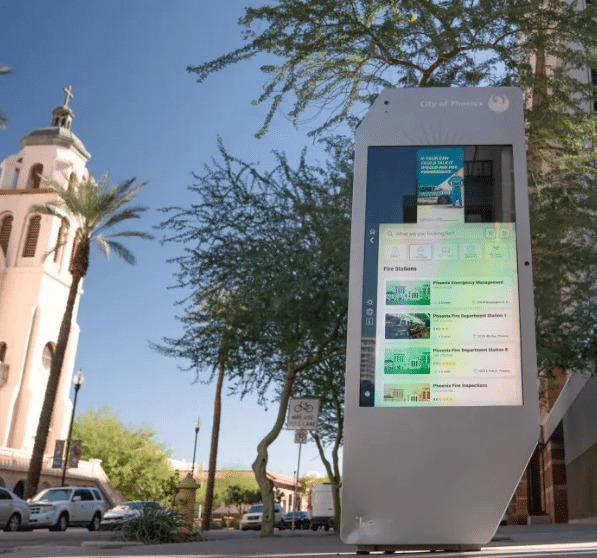
An IKE kiosk on the corner of N 3rd Street & E Monroe Street in downtown Phoenix on October 15, 2026. (Photo by Lavanya Paliwal/Cronkite News)
Interactive smart city kiosks are becoming part of the urban infrastructure in downtown Phoenix and Tempe, Arizona, combining digital wayfinding, public information, emergency assistance and advertising-supported services.
A November 12 report by Cronkite News examines the deployment of IKE (Interactive Kiosk Experience) terminals operated by IKE Smart City. The two cities currently have 32 operational kiosks—18 in Phoenix and 14 in Tempe—with two additional units under construction in Phoenix.
The interactive displays provide free public access to:
- Wayfinding and transportation: Local maps, transit schedules, nearby businesses and attractions.
- Community services: Housing assistance, employment opportunities, food support, healthcare and addiction recovery resources.
- Public safety: Emergency 911 calling, weather warnings, road closures and public alerts.
- Digital connectivity: Free Wi-Fi, local event information and weather and air quality updates.
- Entertainment: Interactive photo booths and arcade games.
Advertising-Funded Urban Infrastructure
An important feature of the IKE model is its financing. The kiosks are installed without upfront city expenditure, supported by digital advertising displayed when the terminals are not being used.
Phoenix receives a guaranteed minimum of $14,000 annually per operational kiosk, with opportunities for additional advertising revenue. At 18 operational locations, that represents a minimum annual payment of $252,000.
Smart City Insight
The deployments illustrate how digital street furniture can serve multiple municipal objectives: public communication, economic development, digital inclusion and revenue generation.
However, the long-term question is public engagement. Cronkite News reported observing little direct kiosk interaction during visits to downtown Phoenix. As smartphone capabilities continue to expand, cities will need to evaluate whether interactive kiosks deliver sufficient public value beyond their advertising and signage functions.
The strongest argument for these systems may be their ability to provide essential information and emergency services to residents who lack reliable smartphone or internet access.
Source: Cronkite News — Here is what IKE kiosks in downtown Phoenix and Tempe offer users, Natalia Rodriguez, November 12, 2026.